DevOps in 2025: The Future of Continuous Integration and Deployment
DevOps bridges the gap between development and operations, creating faster and more reliable software delivery. This guide explores the latest DevOps trends, tools, and practices that define modern software engineering in 2025.
Introduction: What Is DevOps and Why It Matters in 2025
In today’s fast-paced digital world, delivering software quickly and reliably has become a top priority. That’s where DevOps comes in — a culture and practice that bridges the gap between development (Dev) and operations (Ops) to ensure faster delivery, better collaboration, and improved reliability.
By 2025, DevOps is no longer a buzzword — it’s a necessity. Companies across industries are integrating DevOps to stay competitive, reduce time-to-market, and scale their digital infrastructure effectively.
🚀 Understanding the Core of DevOps
DevOps is not a tool or framework — it’s a mindset. It encourages collaboration, automation, and continuous improvement across the entire software lifecycle — from code development and testing to deployment and monitoring.
🔑 Core Principles of DevOps:
- Collaboration and Communication between teams
- Continuous Integration and Continuous Delivery (CI/CD)
- Automation of Repetitive Tasks
- Infrastructure as Code (IaC)
- Continuous Monitoring and Feedback Loops
- Security Integration (DevSecOps)
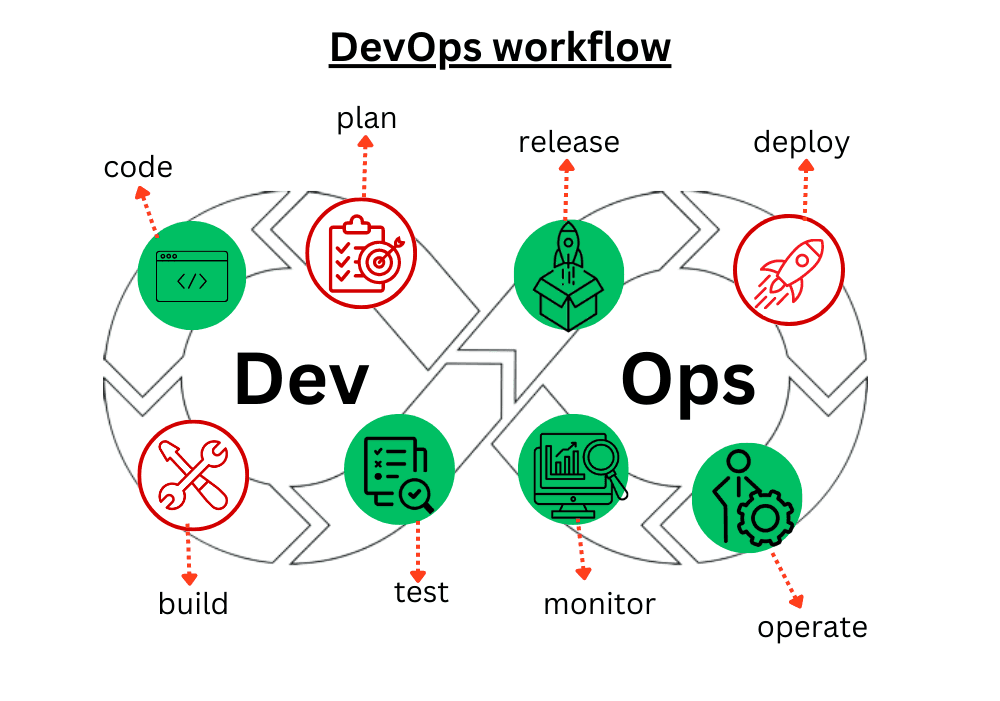
🧩 The DevOps Lifecycle Explained
DevOps follows a continuous lifecycle, ensuring every phase feeds into the next for seamless software delivery.
🔁 1. Continuous Development
Developers write, plan, and manage code versions using tools like Git, GitHub, and GitLab.
⚙️ 2. Continuous Integration (CI)
Code changes are automatically tested and integrated into a shared repository. Tools like Jenkins, CircleCI, and GitHub Actions ensure stability and prevent integration issues.
🚀 3. Continuous Deployment (CD)
Once tested, the code is automatically deployed to production using platforms like AWS CodeDeploy, GitLab CI/CD, or ArgoCD.
🧱 4. Continuous Testing
Automated tests verify every new build to maintain software quality. Frameworks like Selenium, JUnit, and Cypress are commonly used.
☁️ 5. Continuous Monitoring
Monitoring tools such as Prometheus, Grafana, and New Relic track system performance, helping teams fix issues before users notice.
🔒 6. Continuous Feedback and Optimization
Feedback loops allow teams to improve product performance, security, and user satisfaction over time.
🧰 Key Tools in the DevOps Ecosystem
The power of DevOps lies in its ecosystem of tools that automate, integrate, and optimize the entire workflow.
CategoryPopular ToolsPurposeVersion ControlGit, GitHub, BitbucketManage and track code changesCI/CDJenkins, GitLab CI, CircleCIAutomate build, test, and deploymentConfiguration ManagementAnsible, Puppet, ChefManage server configurationsContainerizationDocker, PodmanPackage and run apps in isolated environmentsOrchestrationKubernetes, OpenShiftManage containerized workloadsMonitoringPrometheus, Grafana, ELK StackTrack app and infrastructure healthCloud PlatformsAWS, Azure, Google CloudHost and scale applications globally
🧠 Benefits of DevOps in Modern Web Development
⚡ 1. Faster Software Delivery
Automation and CI/CD pipelines allow faster feature releases and bug fixes.
💪 2. Improved Collaboration
Developers and operations teams work together, breaking down silos and fostering shared responsibility.
🧩 3. Higher Software Quality
Continuous testing and monitoring ensure early detection of errors and improved stability.
🌐 4. Scalability and Flexibility
With cloud integration and container orchestration, applications can scale easily to meet user demands.
🔒 5. Enhanced Security (DevSecOps)
Security is integrated into every phase of development, preventing vulnerabilities early.
🏗️ Infrastructure as Code (IaC): The Backbone of DevOps
Infrastructure as Code allows teams to define and manage infrastructure using configuration files instead of manual processes.
Example using Terraform:
resource "aws_instance" "web" {
  ami           = "ami-123456"
  instance_type = "t2.micro"
  tags = {
    Name = "DevOpsWebServer"
  }
}
This code automatically provisions a web server on AWS — no manual setup required.
🧩 DevOps and Cloud: A Perfect Match
Modern DevOps practices are tightly coupled with cloud computing.
Platforms like AWS, Azure, and Google Cloud provide managed CI/CD tools, Kubernetes clusters, and scalable infrastructure.
Benefits of Cloud-Driven DevOps:
- Auto-scaling based on demand
- Reduced infrastructure cost
- Easy deployment through pipelines
- Built-in monitoring and security
🔮 Future Trends in DevOps for 2025
🤖 1. AI and Machine Learning in DevOps (AIOps)
AI-driven analytics are helping teams predict outages, automate root cause analysis, and optimize CI/CD pipelines.
🧠 2. GitOps
An evolution of DevOps where Git repositories act as the single source of truth for infrastructure automation.
🛡️ 3. DevSecOps
Integrating security directly into DevOps pipelines ensures vulnerabilities are detected before production.
☁️ 4. Serverless DevOps
Developers can now deploy code without managing servers using AWS Lambda, Google Cloud Functions, and Azure Functions.
⚡ 5. Edge Computing Integration
With IoT and 5G growing, DevOps is expanding beyond the cloud to manage deployments on edge devices.
🧭 Best Practices for Effective DevOps Implementation
- Start small — automate one process at a time.
- Adopt CI/CD early to improve delivery cycles.
- Monitor everything — from infrastructure to user behavior.
- Use version control for both code and infrastructure.
- Encourage collaboration and shared ownership.
- Embrace security as part of development.
🚀 Real-World Example: Netflix and DevOps
Netflix is a global leader in DevOps adoption.
They use:
- Spinnaker for multi-cloud continuous delivery
- Chaos Monkey for failure testing
- AWS for cloud infrastructure
Result:
- Deploys thousands of changes daily
- Near-zero downtime
- Seamless user experience across millions of devices
🏁 Conclusion
DevOps is more than a methodology — it’s a culture of collaboration, automation, and continuous improvement.
In 2025, DevOps continues to evolve with AI, automation, and cloud integration at its core. Whether you’re building startups or enterprise systems, embracing DevOps will transform how you deliver software — faster, safer, and smarter.
DevOps in 2025 | The Future of Continuous Integration and Deployment
Explore how DevOps is shaping modern software development in 2025. Learn about automation, CI/CD pipelines, cloud infrastructure, and the best practices driving faster, smarter deployments.
Related Topics
Leave a Comment
Comments (0)
No comments yet. Be the first to comment!